
PEG tube site care raises one question more than any other in the homes we visit: should there be gauze around the tube or not? Many families insist on it. In our experience, once the stoma has healed, the gauze often causes more problems than it solves.
This guide explains where the gauze habit comes from, why open to air is the usual practice after healing, and when to call the doctor. If the skin around the tube is already sore, our wound care at home in Dubai and home nursing in Dubai teams can help.
Please note: this guide is for adults with a PEG tube and describes usual practice only. Always follow your treating doctor’s guidance, and get a doctor’s order before using gauze, dressings, creams or ointments on the stoma.
Where the Gauze Habit Comes From
A PEG tube is placed in hospital during a procedure. Afterwards, the opening in the tummy (the stoma) is a fresh surgical wound, so a dressing is needed while it heals. Many hospitals keep a gauze dressing on for about the first month.
The problem is that families are rarely told when to stop. So the gauze stays, week after week, long after the stoma has healed. It also simply feels safer to have something there.
PEG Tube Site Care After Healing: Open to Air
Once the stoma has healed, the usual practice is no gauze at all. Our nursing practice matches the ESPEN guideline on home enteral nutrition. Once the stoma has healed, the guideline says “dressings can be omitted and the site can be left open”, and it keeps the same small gap of 0.5 to 1 cm at the outer disc. Our nurses follow the ASPEN and ESPEN guidelines on tube management.
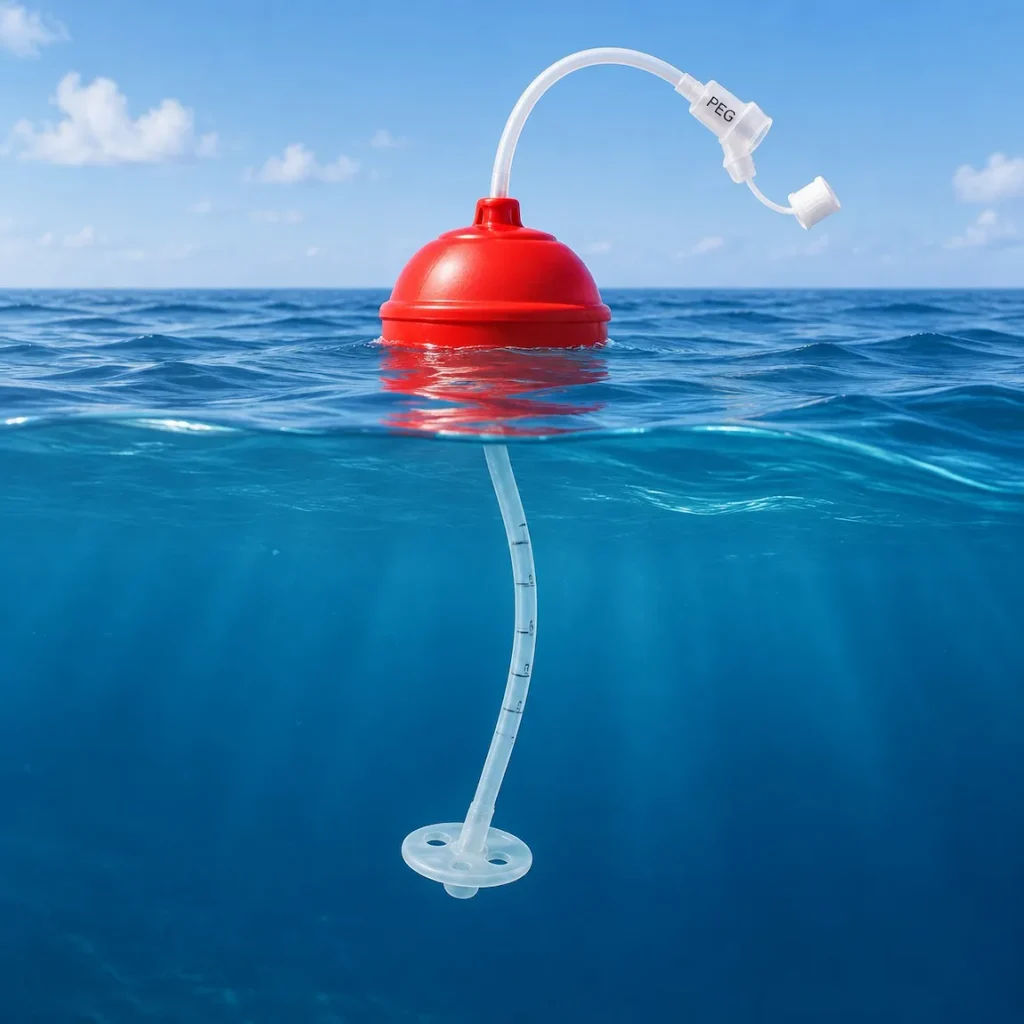
Think of a buoy on the sea
Inside the stomach, a soft disc (bumper) or balloon holds the tube in place. Outside, a second disc sits on the skin. The tube should move up and down a little, like a buoy bobbing on the sea, because the tummy rises and falls with breathing, feeds and gas. ESPEN advises a small gap of about 0.5 to 1 cm between the skin and the outer disc.
What gauze under the outer disc does
When gauze is packed between the skin and the outer disc, that gap disappears. As a result:
- Tension rises. The tube is pulled tighter, and the inner bumper is pulled up against the stomach wall. Too much tension is linked to a serious complication called buried bumper syndrome, where the inner disc grows into the stomach wall.
- Friction rises. The tube can no longer bob freely, so the gauze rubs the skin. The skin reacts by forming small, raised, bubbly lumps called granulation tissue.
- Moisture builds up. Damp gauze keeps the skin humid, which encourages fungal infection.
Daily PEG Tube Site Care: The Usual Routine
Care for the stoma the way you would care for your lips: gently, keeping it clean and dry. A healed stoma is simple to look after:
- Clean your hands.
- Clean the skin around the tube with mild soap and water, or normal saline.
- Clean the outer disc and the tube where it meets the skin.
- Dry everything well, including under the outer disc.
- Leave it open to the air. No gauze, unless the doctor has ordered it.
- Don’t apply powders, lotions, creams or ointments. Follow doctors orders for any creams or ointments or dressings
- Check that the gap at the outer disc is still there and the tube can bob gently.
The tube and its connections need the same care. See our guide to PEG tube hygiene.
Leaking, Redness and Creams: Ask the Doctor First
If you see fluid leaking from the stoma, tell the doctor. Stomach juices are acidic. Think of the burn you feel when you burp up something sour. Acid on the skin causes redness, and over time it can break down the skin around the stoma. Leaking milk feed carries stomach acid too.
Please don’t put any cream or ointment on the stoma without a doctor’s order, even an over-the-counter one. We have seen families apply ointment with the best intentions. It kept the skin damp, the stoma became more irritated, and a fungal infection followed.
Also tell the nurse or doctor if you notice redness that spreads, a smell, pain, swelling, or the bubbly lumps of granulation tissue.
How Home Nursing Helps With PEG Tube Site Care
Our nurses check the stoma, the gap at the outer disc and the daily routine at each visit, and train families and home helpers in your own home, as described in PEG tube and tracheostomy care at home. When the skin needs more than routine care, our wound care at home in Dubai team works with the treating doctor.
Questions to ask before going home from hospital
- When can the gauze dressing be removed?
- How should we clean the stoma, and with what?
- What should we do if there is leaking or redness?
- Can we see the hospital’s stoma nurse before we leave?
See our related PEG tube articles: blocked PEG tube, PEG tube pulled out and PEG tube hygiene.
PEG Tube Site Care: Questions Families Ask
Should there be gauze around a PEG tube?
While the stoma is healing after the procedure, yes, usually for about the first month. After that, the usual practice is no gauze: the site is kept clean, dry and open to air. Ask your doctor when the gauze can come off, and only use gauze afterwards if the doctor orders it.
What does daily PEG tube site care involve?
Clean your hands, then gently clean the skin, the outer disc and the tube with mild soap and water or normal saline. Dry everything well, including under the disc. Leave it open to air, and don’t use powders, lotions or creams unless the doctor has ordered them.
What are the red bumps around my father’s PEG tube?
Small, raised, bubbly lumps are often granulation tissue, the skin’s reaction to friction. Gauze packed under the outer disc is a common cause. Tell the nurse or doctor, who can check the cause and advise on treatment. Don’t apply creams on your own.
Can I put cream on a red PEG tube site?
Not without a doctor’s order. Creams and ointments keep the skin damp, which can lead to fungal infection. Redness may come from leaking stomach acid or friction, and the doctor needs to find the cause. Report it, and follow the doctor’s written instructions.
Good PEG tube site care is simpler than most families expect: clean, dry, open to air, with room for the tube to bob. When in doubt, ask the doctor before adding anything.
If you’re caring for someone with a feeding tube in Dubai, our nurses can help. Please WhatsApp us on +971 55 352 0186 to speak to a nurse.