
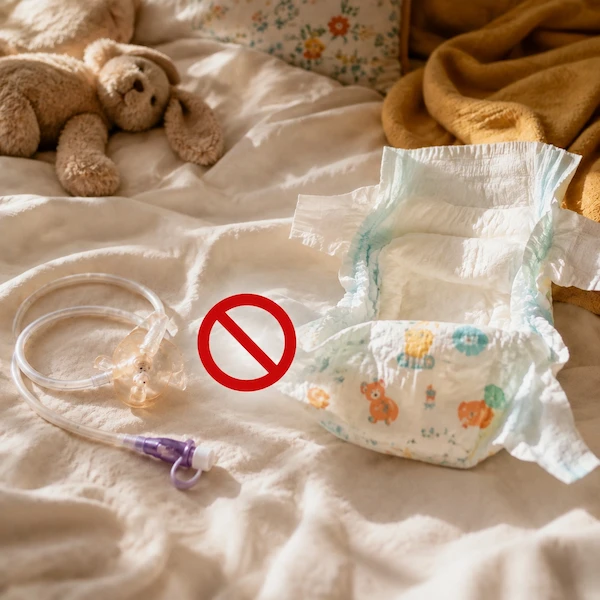
PEG tube hygiene starts with a simple question: where is the tube right now? When our nurses visit homes, one of the most common problems we see has nothing to do with feeds or medicines. It’s where the tube and its connections are kept.
This guide explains a simple way to think about it, the two zones of the body, and the right order for tube care and diaper care. Our home nursing in Dubai team can show you and your home helper each step hands-on.
Please note: this guide is for adults with a PEG tube. Always follow your treating doctor’s guidance and your organisation’s policies.
What We See in Homes: The PEG Tube at the Diaper Line
Again and again, we find the PEG tube connection anchored down at the diaper line. The thinking is understandable. If the feed ever disconnects, the milk goes into the diaper, and the bed stays dry. Some carers also feel the tube is more secure tucked in there.
But this puts a dry bed ahead of a clean tube. The connection is the doorway into your parent’s stomach, and it is sitting in the dirtiest area of the body.
Other common slip-ups we see
- The connection taped to the thigh or tucked inside the diaper
- The connection left uncapped and hanging when the feed is stopped
- Diaper care first, then the PEG tube, with the same hands or gloves
- The feeding line trailing on the floor
- No separation of milk station in the patient room. Milk and syringes lack of storage
Each of these is easy to fix once everyone in the home knows why it matters.
Think of PEG Tube Hygiene Like a Clean Spoon
Here is the picture we teach every carer: the PEG tube is a spoon. Your parent “eats” through it several times a day.
Think about how you treat a spoon. You wash it, dry it and keep it in a clean drawer. You would never store it in a diaper. So, every time you look at the PEG tube, ask yourself: if my parent were eating from this spoon, how would I want it handled?
Two Zones: Above and Below the Belly Button
To keep it simple, divide the body into two zones:
- The clean zone: above the belly button. This is where the PEG tube and its connections belong.
- The dirty zone: below the belly button, including the diaper area.
Keep the tube, the feeding line and the connection above the belly line, ideally resting on the chest, covered and secured with a small loop of tape. Germs don’t only spread by direct touch, so the more physical distance between the connection and the diaper area, the better.
The Right Order: Tube First, Diaper Second
Before you change a diaper, turn your parent or give a bed bath, deal with the PEG tube first:
- Clean your hands.
- Wipe the outside of the PEG connection, as your nurse has shown you.
- Stop and disconnect the feed.
- Flush the tube with water, using a syringe.
- Close the cap and cover the connection.
- Place it above the belly line, on the chest.
- Only then, go to the diaper area.
One firm rule: once your hands have gone below the waist, they don’t go back up to the tube. Finish the diaper care, remove your gloves, clean your hands, and only then touch the PEG tube again.
The ASPEN Safe Practices for Enteral Nutrition Therapy also stress hand hygiene and keeping every connection, syringe and container clean and dry. Our nurses follow the ASPEN and ESPEN guidelines on tube management.
How Home Nursing Supports PEG Tube Hygiene
Good habits only work when everyone in the home follows them, including family, home helpers and night carers. Our nurses train the whole team in your own home and check the routine at each visit, as described in PEG tube and tracheostomy care at home.
A nurse can also review how the tube is secured, the safe PEG feeding position and the daily flushing routine. If you notice redness, discharge or a smell around the tube, or your parent has a fever, tell the nurse or doctor.
See our related PEG tube articles: blocked PEG tube and PEG tube pulled out.
PEG Tube Hygiene: Questions Families Ask
Where should a PEG tube be secured?
Above the belly button, in the clean zone, ideally resting on the chest and covered. Secure it with a small loop of tape so a tug doesn’t pull on the stoma. Keep the connection away from the diaper area, even if that feels safer for keeping the bed dry.
Is it OK to tape the PEG tube near the diaper?
No. The diaper area is the dirtiest part of the body, and the connection is the way into your parent’s stomach. A wet bed can be changed, but an infection is much harder to deal with. Keep the tube and connections above the belly line.
Should I do the diaper change or the PEG tube first?
The PEG tube first. Clean your hands, wipe the connection, disconnect, flush, cap and cover it, and place it on the chest. Then do the diaper care. Once your hands have been below the waist, clean them before touching the tube again.
What is the simplest rule for PEG tube hygiene?
Treat the PEG tube like a spoon your parent eats from. Keep it clean, dry, covered and above the belly button, and handle it with clean hands, before any diaper care.
PEG tube hygiene is not complicated, but it does need everyone in the home to think the same way. Picture the spoon, respect the two zones, and always care for the tube before the diaper.
If you’re caring for someone with a feeding tube in Dubai, our nurses can help. Please WhatsApp us on +971 55 352 0186 to speak to a nurse.